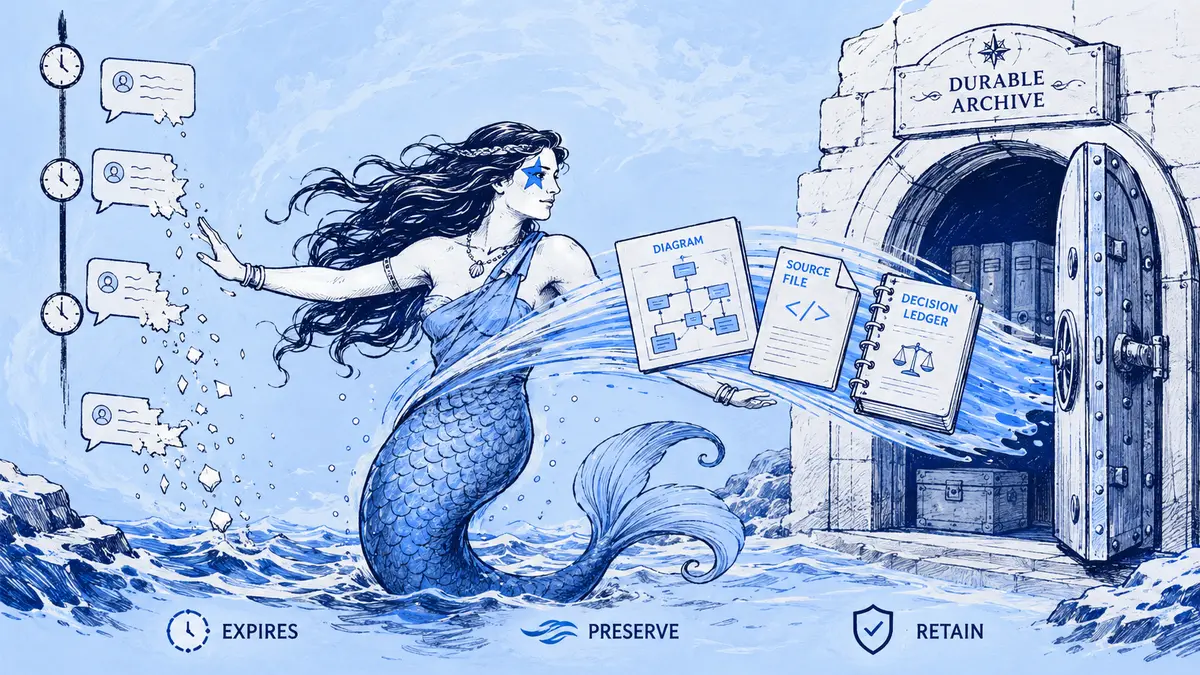
A diagram still shows the retry queue, but the Slack message explaining why it was added has disappeared under the workspace's retention policy. The picture survives; its rationale does not. Slack's retention settings govern how long different workspace content remains available, and the exact policy varies by plan and organization. Architecture teams should preserve the accepted outcome in a durable record, not assume a link to a conversation will always explain it. The practical test is whether someone without the original thread can still understand the current system and the decision behind it.
Direct answer: Find out what your workspace actually deletes and when: channels, private channels, and DMs can have different settings. On Slack's Free plan, only the last 90 days of history are visible, and data older than a year is deleted. Do not treat Slack history as your architecture record. When a decision is accepted, capture the current diagram, a short reason that still makes sense without the thread, the author and date, and the editable source.
What Slack's retention settings do
According to Slack's data retention documentation:
- Every plan has retention settings, and paid plans have more granular controls.
- Retention can be set separately for public channels, private channels, and direct messages.
- Retention applies to messages, files, canvases, and lists, including pinned and saved items. Data deleted by a retention setting is gone permanently.
- On the Free plan, workspaces choose between keeping data for one year or deleting it after 90 days. Only the most recent 90 days of history can be viewed and searched (free plan limits).
Slack also documents how retention applies to canvases and lists. Do not assume a canvas will outlive the messages around it.
Your workspace's actual configuration is what matters. Ask your admin for the settings that apply to your channels and DMs, and whether legal holds or exports change them.
Which architecture knowledge is most at risk
The messages that matter most usually look ordinary when they are written:
- a senior engineer explaining why a service owns a workflow;
- a cross-team contract change agreed in a DM;
- an incident thread that exposes a hidden dependency;
- reviewers agreeing on a retry, queue, or trust boundary;
- a diagram image uploaded without its editable source.
When these disappear, the implementation remains but the reasoning becomes tribal knowledge. DMs are the highest risk, because they are invisible to the team and may have shorter retention. See why architecture decisions should not live in DMs.
Preserve the outcome, not the whole thread
A monthly export ritual is better than nothing, but it is easy to forget and produces a pile nobody reads. Capture when the decision is accepted. For a diagram-changing decision, keep:
- the new current diagram and the previous version;
- the editable diagram source;
- a reason written to make sense without the original thread;
- who made the change, and when;
- a link to the source message, while it exists.
Copying full threads into another system is usually a mistake. It duplicates personal data, creates its own retention problem, and is still hard to read.
Test what survives a missing thread
Suppose the message that approved a new retry queue is no longer visible to a future engineer because of retention or access changes. A preserved diagram that merely links to that message is still incomplete. The board or linked design record should say what the queue does, who owns it and why it was accepted. Then the unavailable Slack link becomes useful provenance when access returns, rather than the only explanation.
Use Arialine as the working diagram record while the team reviews changes in Slack, and export the source and decision summary to the organization's durable documentation location when policy requires it. Run a small access test with an account that cannot read the original channel: can that reader identify the current structure and the reason for it from the exported material? Slack's retention guidance describes what can be deleted; the actual policy must be checked in your own workspace.
Where Arialine fits
Arialine stores board state (versions, Mermaid source, change summaries, authors, dates, and source-message references) in its own database, outside Slack message history. So a board's current diagram and version history do not depend on the original thread still existing. The rendered files and ledger Arialine posts into Slack are ordinary Slack content, though. Your retention settings apply to them like any other message, file, or canvas. A source link in History still points to a Slack message that may have been deleted.
That makes the practical advice the same with or without Arialine: write the reason into the request itself. "Add a retry queue so worker failures do not lose paid orders" survives the deletion of the discussion around it. "Do what we said above" does not. Data handling is described in the Privacy Policy. Admins evaluating the app can start at security and data handling.
Test before you rely on it
Run a small retention drill with your Slack admin. Create a test thread, a file, a canvas, and an app-created message in a channel with a short retention period. Confirm what remains after the policy runs. Base compliance decisions on observed behavior and your written policy, not on assumptions or a vendor blog post, including this one.
Test the retention boundary with real artifacts
Slack's retention settings can apply differently to messages and files, and plan or administrator settings may change what members can retrieve. A link to a Slack message is therefore evidence only while the destination still exists and the reader still has access.
Create a test channel with a message, diagram file, Canvas link and external system link. Document what your configured policy retains, what an export contains and what disappears after deletion. Keep the accepted architecture outcome in the system your organisation chose for durable records; do not assume a bot's copy escapes Slack's policy.
Next step: repeat the test whenever plan, retention or legal-hold settings change and update the runbook with the observed result.
FAQ
Are Slack canvases exempt from retention?
No. Slack's documentation says retention settings apply to canvases and lists as well as messages and files.
Does a paid Slack plan keep everything forever?
Paid plans default to keeping data, but owners can configure deletion schedules. Check your workspace's settings.
What is the minimum retention-safe record?
A current diagram or written state, its editable source, a reason that stands on its own, the author, and the date.

 Add to my Slack