Why teams stop trusting architecture documentation
Architecture documentation loses value nonlinearly: once readers expect errors, they stop checking even the parts that remain correct.
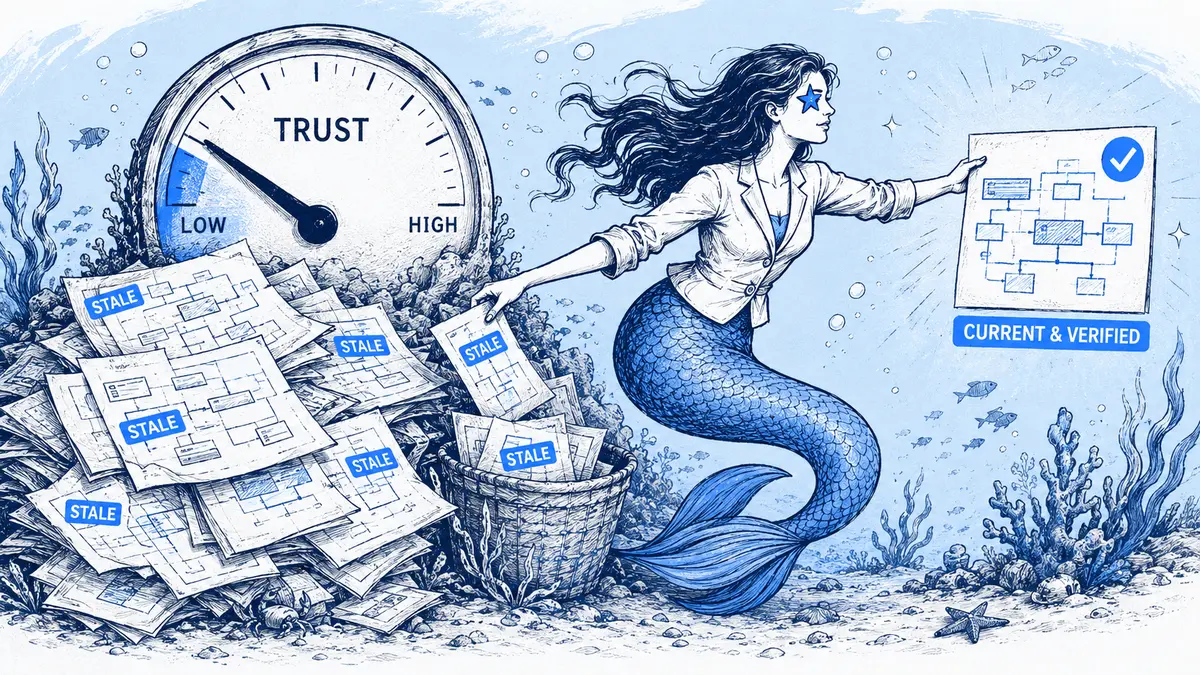
A diagram can be mostly correct and still be useless. Once a team believes architecture documentation is unreliable, people stop opening it and return to code reading, oral explanations, and private messages.
Direct answer: Trust collapses when documentation looks current but contains unknown amounts of drift. Prevent that by keeping the authoritative set small, labeling historical material clearly, assigning update triggers, and recording changes as versions. It is better to maintain two trusted diagrams than twenty impressive pages nobody believes.
Trust is binary in practice
Readers rarely calculate that a document is "60 percent valid." They ask whether they can safely use it. If one visible dependency is wrong, every other part becomes suspect.
This is why partial neglect creates a feedback loop:
- the diagram drifts;
- a reader finds an error;
- the reader stops using the diagram;
- fewer people notice future drift;
- maintenance feels less worthwhile;
- the document becomes ceremonial.
The problem is not only accuracy. It is uncertainty about accuracy.
Official-looking fossils are dangerous
A signed-off architecture deck often remains polished long after the system changes. Because it looks authoritative, new employees and adjacent teams may rely on it. An explicitly archived document is safer than an unlabeled fossil.
Every architecture artifact should state one of three statuses: current, historical decision, or draft. Avoid ambiguous "documentation" folders where all three are mixed.
Shrink the trusted surface
Do not try to keep every implementation detail in a manually maintained diagram. Preserve the broad relationships that people need for onboarding, review, incidents, and cross-team work. Let code, infrastructure definitions, schemas, and generated documentation own volatile details.
A maintainable architecture map usually shows boundaries, major services, key data flows, external systems, and ownership. It does not reproduce every class or endpoint.
Add explicit update triggers
Documentation should change when the architecture changes, not when someone feels guilty. Useful triggers include:
- a pull request changes a boundary or contract;
- a review accepts a new dependency;
- an incident reveals a missing component or flow;
- a team or owner changes;
- a new hire finds a mismatch;
- a quarterly review confirms or archives the artifact.
Triggers make maintenance observable and fair.
Preserve history without confusing it with current state
Historical diagrams and ADRs are valuable because they explain past reasoning. They should remain immutable or versioned. The current map can evolve while linking back to those decisions.
This separation prevents the team from rewriting history every time the system changes.
Where Arialine fits
Arialine keeps one current diagram on the Slack anchor message and preserves superseded versions in the thread and Canvas ledger. That model helps separate "current" from "historical" without deleting context.
The product's value is not more documentation. It is a smaller, clearer chain from conversation to accepted current state.
FAQ
Should we delete inaccurate documentation?
Archive it with a clear historical label if it explains past decisions. Delete it when it has no continuing value and could mislead readers.
How many architecture diagrams should be current?
Only as many as the team can keep trustworthy. Start with the top-level system map and the few flows that drive frequent decisions.
Can automation restore trust?
Automation can detect gaps and reduce update effort. Trust still depends on clear ownership, review, and visible status.
Try it in context
Bring Arialine into your Slack
Turn the next architecture conversation into a diagram the team can keep reviewing.