Slack search is useful, but it is not an architecture knowledge strategy
Search can recover messages; it cannot reliably tell a team which architecture was accepted or which diagram is current.
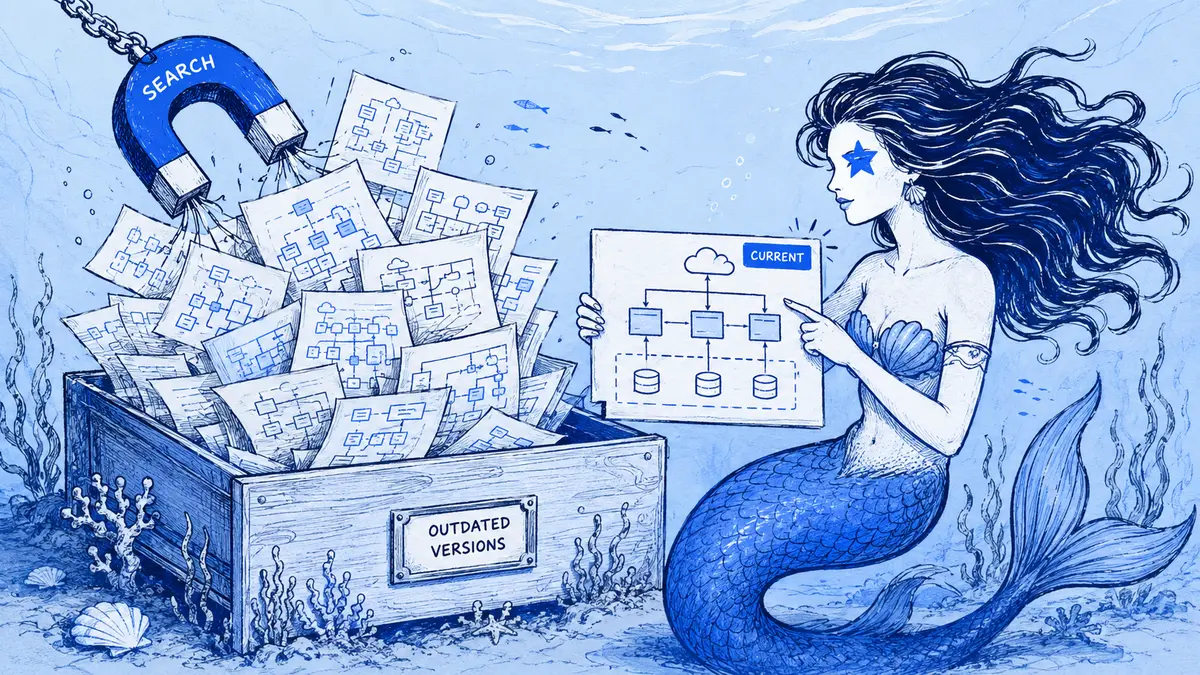
Slack search is often surprisingly good. Slack AI can make retrieval faster. Neither solves the central architecture problem: a search result can show what people said, but it does not automatically identify the accepted decision or the current system state.
Direct answer: Use search to recover context, not to define the source of truth. Critical architecture knowledge needs a maintained artifact with an obvious current version, editable source, and links to the decisions that changed it. Search should support that artifact, not replace it.
Search returns evidence, not authority
Imagine searching for "checkout retry queue." The results may include an early proposal, a rejected alternative, an incident discussion, an old diagram, and the final implementation note. Every message is relevant, but only one reflects the accepted design.
A search engine ranks matches. It does not know which message your team considers normative unless that status was recorded somewhere.
This distinction matters because architecture is full of superseded ideas. A proposal can look more detailed than the final decision. An old diagram can receive more reactions than the current one. Search quality cannot fix missing governance.
The current-version problem
Teams often upload several images or link several boards during a review. Months later, search finds all of them. The reader now has a new task: determine which diagram is current.
A durable workflow should make that answer obvious without comparing timestamps or reading every reply. One anchor artifact should display the latest render, while historical versions remain available as history rather than competing sources.
The missing "why" problem
Even when search finds the right diagram, the reasoning may be distributed across replies. The reader sees that a queue exists but cannot tell whether it was added for rate limiting, retries, isolation, or compliance.
A decision ledger reduces that ambiguity. Each change should include a concise reason and a link to the source message. Search can then provide broader context when needed.
When search is enough
Search is appropriate for low-risk information: discovering who worked on a service, locating an old incident thread, or finding a command someone pasted. It is less appropriate for facts that should be stable and shared, such as service ownership, trust boundaries, data flows, and accepted architecture decisions.
The more expensive a wrong answer would be, the less you should depend on search alone.
Where Arialine fits
Arialine connects retrieval and capture. The Slack thread remains the conversational evidence, while the root diagram and Canvas ledger present the current state and decision history. Slackbot can query Arialine through MCP, but the answer comes from a structured board rather than a loose set of messages.
That is the difference between asking an assistant to search the past and giving it a maintained artifact to reason from.
Practical rule
Use this sentence in your team policy: "Search helps us find context; the current diagram and decision record tell us what we agreed." It is simple enough to remember and specific enough to change behavior.
FAQ
Can Slack AI identify the final decision automatically?
It can summarize and retrieve, but accuracy depends on the available messages and how clearly agreement was expressed. For important decisions, record acceptance explicitly.
Does a decision ledger duplicate the thread?
No. The ledger contains the decision and source link, not the full discussion. The thread remains the detailed evidence.
Should the diagram live outside Slack for safety?
It may also live in a repository or documentation system. The important requirement is one clearly identified current version with traceable history.
Try it in context
Bring Arialine into your Slack
Turn the next architecture conversation into a diagram the team can keep reviewing.