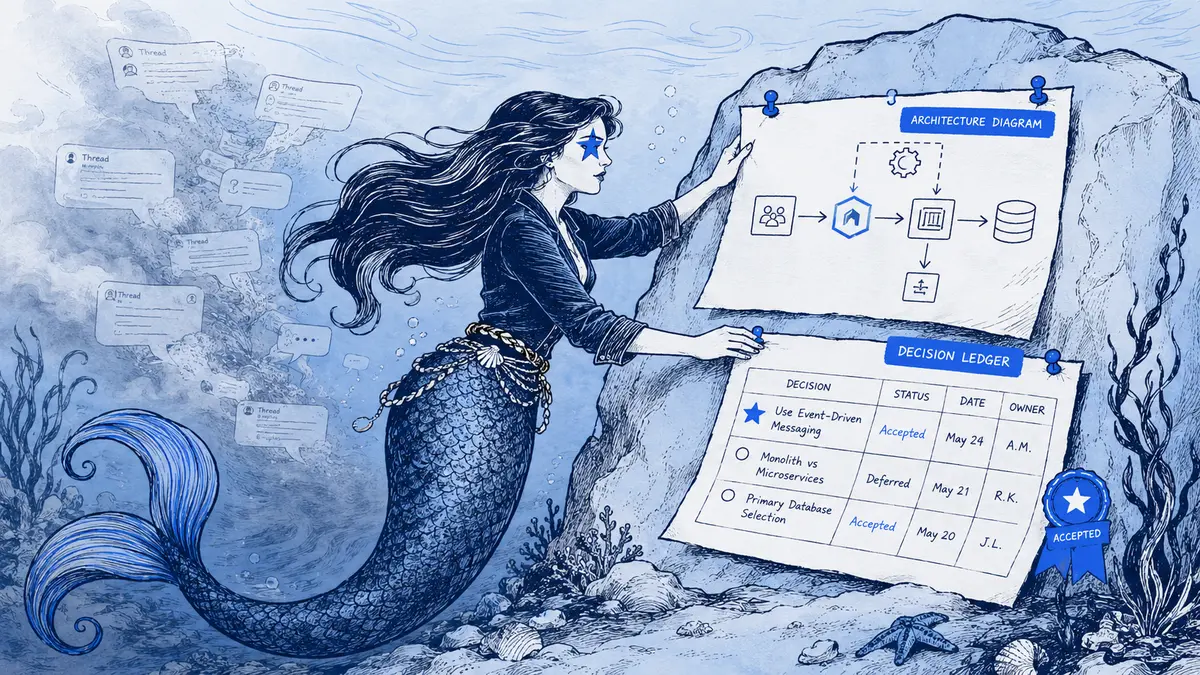
Direct answer: When a Slack discussion settles an architecture question, post the accepted outcome in plain language and copy it into the team’s durable decision record—usually an ADR in the affected code repository. Record its status, context, chosen option, material trade-offs, owner, date, and links to the exact Slack messages and current diagram version. Leave it marked proposed until the person or process with decision authority accepts it. Search can find the evidence; the record tells the next engineer what the team accepted and what it replaced.
An architecture decision record (ADR) captures a significant choice with its rationale and consequences. A diagram can show the resulting structure, but it does not by itself say whether that structure is proposed, accepted, or implemented.
Why searchable Slack history is not enough
Suppose a checkout thread compares a synchronous fraud check with an asynchronous queue. One person proposes the queue, another asks what happens when the provider times out, and a third says “let’s do that” after several alternatives. Months later, search returns the thread. A new engineer still needs to determine which option was accepted, whether the timeout caveat changed the decision, and whether the architecture map reflects the current choice.
The problem is not that every thread is hard to find. It is that a discussion and a decision record do different jobs. The discussion keeps the working context; the record makes the outcome, status, and rationale legible without reconstructing the whole exchange. A useful record preserves only the messages that support the choice, not a transcript of every reply.
Slack history also has workspace retention settings. Administrators can configure how long messages and files remain, and pinned or saved messages still follow the applicable retention policy. Check your workspace’s settings before treating a message permalink as the only durable copy of an important decision. The related guide to Slack retention and architecture knowledge explains the same risk for system rationale. Slack’s retention guide explains the available policies.
Decide which Slack discussions need a durable record
Write down a decision when it changes something future work depends on: system structure, a quality requirement such as security or availability, a component dependency, an API or other published contract, or a construction choice such as a framework or deployment pattern. Those are among the decision categories covered by AWS Prescriptive Guidance on ADRs.
A typo fix, local implementation detail, or one-off debugging hypothesis usually belongs in its pull request or issue, if it needs to be retained at all. The goal is not an ADR for every technical conversation. Capture decisions whose context a later engineer would otherwise have to rediscover or might incorrectly reverse.
Use a short close-out workflow
| Step | What to do | What the next reader should be able to verify |
|---|---|---|
| 1. Confirm the state | Restate the selected option and say whether it is proposed, accepted, rejected, or superseded. Name the decision owner or the review process that accepted it. | A suggestion or reaction is not mistaken for the team’s accepted choice. |
| 2. Preserve the reason | Record the problem, constraints, important alternatives, and the trade-offs that mattered. Keep only the reasoning that explains the choice. | A reader can tell why this option fit and what it costs. |
| 3. Update the durable record | Put an application-specific ADR in that application’s version-controlled repository. Use the team’s established design record for cross-cutting decisions. | There is one canonical record to update when the decision changes. |
| 4. Align the diagram | If the choice changes relationships, update the relevant view and identify whether it shows target or deployed state. Link to its source and version. | The picture and the written decision describe the same state. |
| 5. Close the Slack loop | Reply in the original thread with the outcome and links to the record and diagram. Keep the implementation task separate. | Search finds a short route from the discussion to the current answer. |
The UK Government Digital Service recommends keeping architecture decisions in version control, with decisions for a specific application in that application’s repository and broader decisions in central documentation where useful. The right home depends on who must find and maintain the decision; the important part is naming one canonical home and linking back to the discussion.
Scale the effort to the decision
For a clear, single-service decision with one accountable owner, the close-out can be a short ADR entry and a link from Slack. If a choice changes a shared API, data flow, security boundary, or availability behavior, involve affected service owners and reviewers before labeling it accepted. The five-step checklist stays the same; the evidence and review should grow with the decision’s impact. There is no useful fixed time estimate without knowing the scope and your team’s review process.
Copy this lightweight decision record
Adapt the fields to your team’s existing ADR template. For a small decision, a few sentences can be enough; keep the status and source links even when the rationale is short.
Title: <decision, not just the problem>
Status: Proposed | Accepted | Rejected | Superseded
Decision owner / acceptance process: <person or named review process>
Context: <constraint or requirement that made a choice necessary>
Decision: <one clear sentence stating what the team will do>
Alternatives: <only the options and reasons a future reader may need>
Consequences: <important benefits, costs, and new obligations>
Effective from: <condition, merge, release, or date if relevant>
Implementation status: <not started | in progress | verified in ...>
Source discussion: <permalink to the acceptance message and relevant context>
Related design: <diagram, source file, and version if applicable>
Supersedes / revisit when: <earlier record or concrete trigger, if any>
Keep decision status separate from implementation status. Accepted means the accountable process chose the option; it does not prove the code has shipped or production matches the diagram. If the decision changes later, mark the old record superseded and link the new one rather than silently rewriting history. AWS describes the context, decision, consequences, and lifecycle expected in an ADR.
Worked example: synchronous check or queue
Example: a team considers whether checkout should make a synchronous fraud check or send the check through a queue.
Assume the team accepts a queue because checkout should not wait for a fraud provider. A useful record would state the acceptance explicitly, name the owner, preserve why the queue fits, and note the new obligations: asynchronous result handling, retry ownership, and a way to prevent duplicate checks. It should also point to the message that resolved those trade-offs and to the diagram version that shows the chosen path.
flowchart LR
    Checkout[Checkout API] -->|submit check| Queue[Fraud check queue]
    Queue --> Worker[Fraud worker]
    Worker --> Provider[Fraud provider]
    Worker -->|record result| OrderState[Order state]
This small view makes the selected component relationships visible. It does not specify the queue contract, retry policy, or what the customer sees while a check is pending; those belong in the relevant design or implementation documentation. If the choice is still under review, label the diagram proposed rather than presenting it as the live system.
For a consequential decision, the Slack close-out might say: “Accepted: submit fraud checks to the queue; the worker owns provider retries. We still need to define the pending-order behavior. The ADR and checkout diagram are linked here.” That sentence makes acceptance and the unresolved follow-up visible. It does not claim the system is implemented.
Choose a canonical home for each part
| Artifact | Best use | Do not ask it to do |
|---|---|---|
| Slack thread | Discussion, clarification, and links to the outcome and source evidence. | Serve as the only place a major decision’s status and rationale are stated, unless your team deliberately governs Slack as its record system. |
| ADR or design record | Decision status, context, selected option, consequences, ownership, and supersession history. | Replace implementation tasks or claim the deployed system matches the decision. |
| Pull request, issue, or delivery record | Track code changes, rollout, tests, and whether implementation is verified. | Recreate the full reasoning when a link to the accepted decision would suffice. |
| Architecture diagram | Show the components, boundaries, or flow affected by the decision. | Stand in for the decision status, alternatives, rationale, or acceptance evidence. |
A version-controlled ADR is a strong fit for a decision tied to one application because the record can change alongside that application. A central architecture log may be easier to discover for a choice spanning several systems. If the decision depends on formal sign-off, use the team’s approval process; a Slack reaction or a diagram edit is not a substitute for it.
Verify implementation after acceptance
Link the implementation pull request or delivery task from the ADR, and keep the decision status separate from delivery status. Leave the decision marked accepted while implementation is in progress. After rollout, record the environment and revision that were checked; label a diagram deployed only if it matches evidence for that environment. If implementation exposes a constraint that changes the accepted design, document the new decision and connect it to the earlier record.
Use Slack search to retrieve the source, then inspect it
Slack offers AI Search answers on its current Business+ and Enterprise+ plans; legacy plans and add-ons differ, and a member’s or guest’s access can depend on admin settings. When available, AI Search answers in natural language and cites the messages or files it used. Open those citations and check the underlying wording, surrounding replies, and whether a later message reopened or superseded the choice. A cited answer helps locate evidence; it does not set your organization’s decision status. Slack’s guide to AI Search availability, access, and citations.
For an explicit request in a channel where Arialine is invited, the app can use relevant recent discussion and turn a requested design into an editable Mermaid board. Its recent context is limited to messages from the prior 72 hours; older historical retrieval is user initiated and limited to public-channel search. Private channels and DMs are not searched historically, and those search results are not kept as a durable archive. The Slack context guide describes the workflow and limits; Slack documents the Real-time Search API’s access and interaction requirements.
A board can keep a diagram’s revisions and the Slack requests that informed them together. That helps when the question is “what did this view look like after the review?” It does not tell Arialine who had authority to decide, prove that everyone agreed, or verify deployed behavior. Keep the accepted rationale in your decision record and use the architecture review workflow when a shared, source-linked diagram is useful. For the distinction between diagram history and decision provenance, see decision ledgers for architecture diagrams.
Check the record with someone outside the thread
Give a teammate who missed the discussion only the Slack close-out message and the linked record. Ask them to answer:
- What was accepted, and by whom or through which process?
- Why did the team choose it, and which trade-off mattered?
- Is the choice implemented, proposed, or still waiting on a follow-up?
- Which diagram version shows the relevant architecture, and is it target or deployed state?
- What would cause the team to revisit the decision?
Start with one recent thread where someone can name the accepted choice. Use the template, link the thread and diagram version, then run the retrieval test. If the decision owner or explicit acceptance is missing, leave the record proposed and ask the owner to confirm before marking it accepted. If a reader needs the original author to interpret “let’s do that,” the close-out is incomplete. If the record and diagram disagree, resolve that mismatch before pointing other work at either as current. The companion guide on ownership for architecture documentation covers who maintains the record after the original thread ends.
FAQ
Should every technical thread become an ADR?
No. Record decisions that affect architecture or future choices. Routine debugging, temporary hypotheses, and small local implementation details can remain in their issue or pull request. Use the team’s lightest record that will still preserve the needed context.
Can Slack AI tell which option the team accepted?
When AI Search is available to your plan and role, it can summarize relevant messages and cite its sources. Read the cited messages and record the accepted state explicitly. The answer is a retrieval aid, not a formal decision or approval event. Slack’s AI feature guide lists current plan and access conditions.
Can the diagram replace the written decision record?
No. A diagram is useful for showing structure and flow. Keep the rationale, alternatives, status, and consequences in text, then link the diagram version that represents the chosen design.
What if our Slack workspace keeps messages forever?
Long retention makes old discussions available, but it does not mark which proposal won, explain the trade-off, or say whether the diagram is current. Record those details once and use the thread as its source.
Update note
Updated September 29, 2026: Reworked the article with a reusable decision-record template, guidance for choosing a canonical home, and verified Slack search, retention, and Arialine context limits.

 Add to my Slack