PR gates for architecture documentation: when they work and when they become theater
PR gates work for repository-owned facts, but fail when the actual architecture decision happened elsewhere and the check cannot detect relevance.
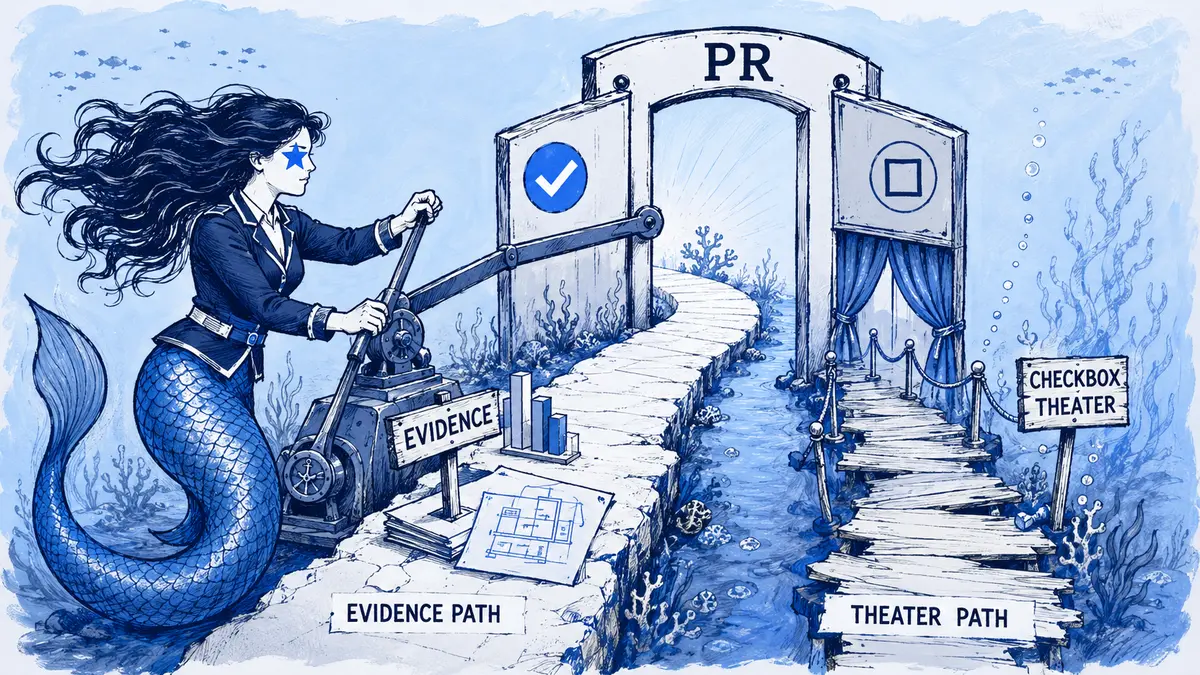
"Make documentation mandatory in every pull request" sounds like a complete solution to architecture drift. It can help, but only when the repository actually contains the authoritative artifact and reviewers can tell whether the change affects it.
Direct answer: Use PR gates for machine-detectable or repository-owned documentation: schemas, generated references, diagrams-as-code, and declared architecture files. For conversation-led design decisions, require a link to the accepted decision and diagram version instead of a generic checkbox. A gate should produce evidence, not merely an affirmation.
Where PR gates are strong
A gate works well when the relationship is explicit. Examples:
- an OpenAPI change regenerates API docs;
- infrastructure changes regenerate deployment views;
- a service boundary change requires editing a known Mermaid file;
- ownership metadata changes update a catalog;
- a changed contract requires a versioned ADR reference.
Automation can detect missing files, stale generated output, or broken syntax.
Where gates are weak
A CI system cannot reliably infer every conceptual architecture change from code. A refactor may introduce a new dependency without touching an obvious file. A feature flag may change data flow. A design may be agreed in Slack but implemented across several repositories.
A checkbox asking "documentation updated?" often becomes ritual. Reviewers click it because the meaning is vague.
Replace the checkbox with evidence
Ask contributors to provide one of three responses:
- "No architecture-relevant change," with a short reason.
- "Updated artifact," with a file or diagram-version reference.
- "Decision supersedes current design," with the ADR or review link.
This takes slightly longer than a checkbox but creates a record that can be audited.
Connect design review and code review
The architecture decision often happens before the pull request. Preserve the accepted diagram version at that time. The PR then proves which decision it implements.
This avoids asking code reviewers to reconstruct the entire design discussion and redraw the system after the fact.
Keep gates proportional
Do not block a typo fix because a global diagram timestamp is old. Gate only artifacts relevant to the changed component or contract. Large organizations may need ownership metadata to route the check to the right team.
A gate that fires too often teaches developers to bypass it.
Where Arialine fits
Arialine can provide a stable board and version reference for a Slack-based architecture decision. The PR can link to that accepted version, while repository automation verifies code-derived documentation.
This creates a hybrid control: conversation captures intent; CI checks implementation-linked facts.
FAQ
Can AI determine whether a PR changes architecture?
AI can flag likely changes, but the decision should remain reviewable. False negatives are especially risky.
Should the diagram source be copied into the repository?
For long-lived code-owned diagrams, often yes. A Slack-native copy can remain the review surface. Define synchronization and authority clearly.
What metric shows whether the gate works?
Track meaningful catches, bypass frequency, update latency, and whether readers trust the resulting artifacts - not just checkbox completion.
Try it in context
Bring Arialine into your Slack
Turn the next architecture conversation into a diagram the team can keep reviewing.