When to archive, delete, or simplify stale architecture documentation
Not every stale artifact should be updated; some should become clearly labeled history, be simplified, or be removed.
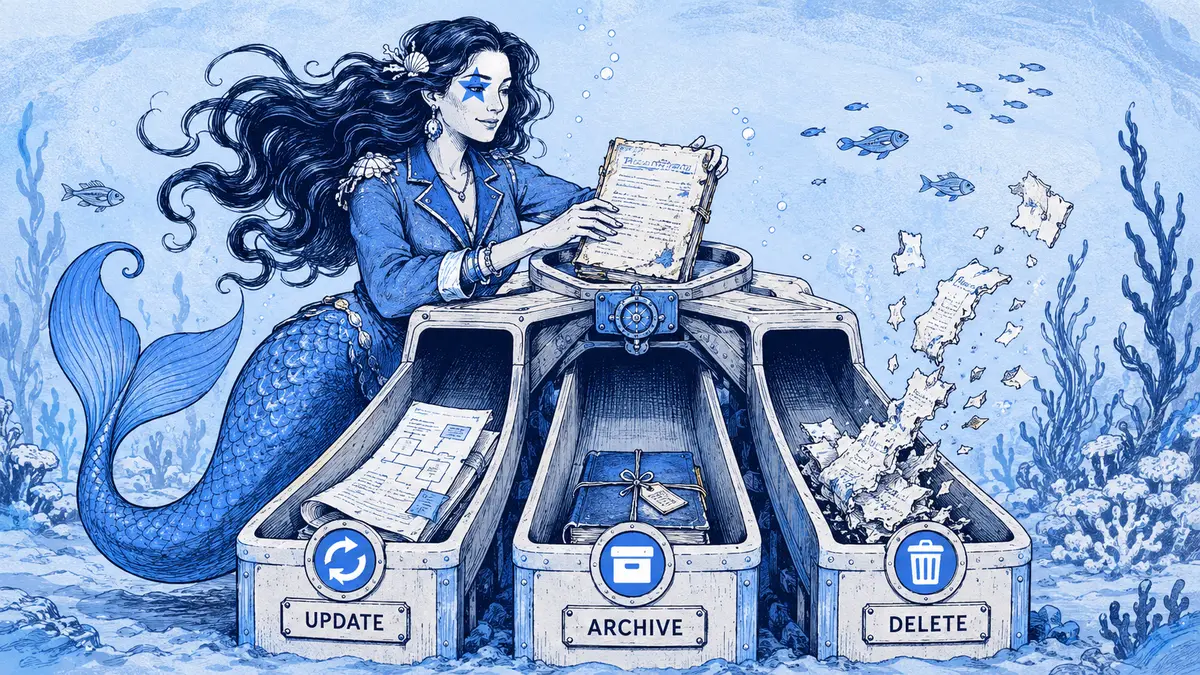
Stale architecture documentation creates two costs: maintenance work and the risk that someone treats it as current. The correct response is not always to update it.
Direct answer: Update a stale artifact when it serves an active audience and its scope is maintainable. Archive it when it explains a meaningful historical decision or past system state. Delete it when it has no continuing value, duplicates a better source, or would mislead readers even with a label. Simplify it when the detail level is the reason maintenance keeps failing.
Update: active and valuable
Update the artifact when teams still use it for onboarding, architecture review, incidents, compliance, or cross-team coordination. Confirm an owner and update trigger before investing effort; otherwise it will drift again.
Do not perform a one-time cleanup without changing the process that caused the decay.
Archive: historically meaningful
Archive signed-off designs, migration plans, and diagrams linked to ADRs when they explain why the system evolved. Add a visible banner with the covered period, superseding artifact, and status.
Historical accuracy does not require current accuracy. The artifact should represent what the team believed at that time.
Delete: noise without value
Delete drafts, duplicates, accidental exports, and orphaned diagrams that have no meaningful history. A directory full of nearly identical files makes the authoritative artifact harder to find.
Deletion should follow your organization's retention and compliance rules. The goal is clarity, not indiscriminate cleanup.
Simplify: too detailed to survive
A diagram that repeatedly drifts may be documenting the wrong level. Remove volatile details and retain stable boundaries, responsibilities, and major flows. Let code, schemas, or generated tools provide lower-level facts.
Simplification is often the highest-value action because it reduces future maintenance.
Use a cleanup checklist
For each artifact, ask:
- Who uses it?
- What decision or task does it support?
- Is another source more authoritative?
- Can the team realistically maintain this level of detail?
- Does it explain a historical choice?
- What harm could an incorrect reader experience?
The answers usually make the correct path obvious.
Where Arialine fits
Arialine preserves diagram versions as an additive history while keeping one current anchor artifact. Boards can be archived when they no longer represent a maintained system. This prevents old versions from competing with the latest one while retaining decision provenance.
FAQ
Is deleting documentation dangerous?
Keeping misleading documentation is also dangerous. Follow policy, preserve meaningful history, and remove noise deliberately.
Should archived diagrams remain searchable?
Yes, but their historical status and superseding artifact should be unmistakable.
How do we simplify a complex map?
Start by removing implementation detail that changes frequently and split distinct audience questions into separate focused diagrams.
Try it in context
Bring Arialine into your Slack
Turn the next architecture conversation into a diagram the team can keep reviewing.